 Prior to leaving for Argentina, we learned that it was the largest country in the world by area (2.7m sq.kms – Oz is 7.6m. sq.kms). This amount of land produces a GDP of USD350m., about one third of what Oz does. Spread over 40 million people, this suggested that the country might not be a high quality one in material terms, and this was the case. GDP per capita is slightly higher than that of Malaysia. The country had of course ranked higher in world economies in earlier times, but a long period of poor government, corruption, unequal distribution of resources has seen it steadily decline.
  The initial flight via Sydney, Auckland and Santiago (Chile) to Mendoza (Argentina) necessitated 23 hours of flying, though we did stopover in Sydney for a couple of days. From Sydney we flew Lan Chile. This airline uses A340s on the Sydney/Santiago leg, and this long flight was reasonably comfortable. Not in the class of SIA, the ‘plane nevertheless had lie flat beds and average quality food (good beer though). The ‘plane was full on both outward and return legs. Between Auckland and Santiago, the route tracks very close to the Antarctic continent, though this cannot be seen.
 After a four hour stopover in Santiago, we took a further LAN flight to Mendoza, our first stop in Argentina.. This was a spectacular flight. Although only 35 minutes in duration, the ‘plane had to climb rapidly to get over the Andes, and at the peak altitude of 22,000 feet we reached, the ‘plane scraped over the top. Had there been any people standing in the snow on the peaks, they would have been higher than we were ! At Mendoza airport, it was good to see our luggage arrive with us – we had last seen it in Sydney.
  Mendoza (pop. 130,000) is in an important wine growing area of Argentina. Situated on arid country, it is remarkable in that the main streets are all shaded by huge sycamore trees, which makes walking along them quite pleasant,even in high summer. Although wine growing has taken place for 500 years in this area, the quality of the wine produced (particularly Malbec) has reached export quality only recently. Prior to this, the locals drank everything. The locals in Mendoza still boisterously drink large quantities of wine every night in open air cafes, whilst eating enormous pieces of steak grilled on an
  asado, the grill used in a parrilla (steak restaurant). These restaurants are everywhere. Parrilla is not be confused with Parilla, a town on the Mallee Highway in South Australia ! We went to a parrilla for the first dinner we ate in Mendoza. Argentinians claim that their steak is the best in the world, this being dueto the natural grasses on which the animals feed. A more natural flavour is said to be produced because of this, whereas Western cattle are treated with growth hormones, antibiotics etc., thus producing a less natural flavour. Argentinians also eat every part of the beast “except the moo”, and I had to look away when I saw some of the bits and pieces locals ate.
 From Mendoza, we flew to Beunos Aires (BA). This is a huge city, with the Greater BA area having a population of around 13 million. It has become rather a mecca for overseas visitors, and many of these tend to use serviced apartments, as we did. Ours was in Palermo, a suburb a few stations from the city on an underground. Our apartment, located in a very modern building, was managed by an Ozzie of German descent, and we were told that the majority of tourists he sees are from Oz. It was here that we first used supermarkets, and saw that the range
  and qualityof goods sold was not impressive (lots of good beer though,and in 1 litre bottles !). Our suburb abounded in restaurants. A negative is the fact that locals don’t like to dine until 11 p.m or so, and at 7.30 p.m. when we went out looking for dinner, locals could be seen enjoying afternoon coffee and cakes. However, in tourist areas such as ours, restaurants were willing to provide dinners from about 8 p.m. (at that time, they quickly filled with hungry tourists).
 The older buildings in the centre of BA show signs of age and lack of care, but an exception is Puerto Madero. This must be somewhat like Docklands in Melbourne (which I haven’t seen) – an old part of the city near the water, now rejuvenated as an ultramodern shopping and eating area, overlooked by a forest of high rise office buildings. Two other sights in BA come to mind – the cemetery in the suburb of Recoleta where Eva Peron’s body lies (easily found because of the number of people standing reverently outside the crypt).
 The second is the riverine suburb of Tigre, about 30 kms. from BA. This is a labyrinth of muddy channels of the delta, each channel fringed with reeds, but on the raised shore, there are many holiday homes, ranging from impressive mansions to small wooden weekenders. Travel is by boat throughout this area, and interesting sights constantly appear.
  Ever since I saw the movie “The Mission”, and the penitential climb up the face of a waterfall by Robert de Niro, weighed down with heavy pots and pans, I have wanted to see Iguazu Falls, which I think was the waterfall in question. So, we flew from BA to Port Iguazu, the town at the Falls, and about 1000 kms. north of BA. The mist from the Falls can be seen as the ‘plane approaches the airport, aportent of things to come. I had learned beforehand that , in waterfall league tables,Iguaza is not particularly notable. In volume terms, Niagara is well ahead (85,000 cfs, cubic feet a second,versus 61000 cfs)., and this compares with some of
  the falls in Africa which can do more than a million cfs). The Falls are twice as wide as Niagara (2700 metres versus 1203), and their drop is 269 feet versus 167 feet at Niagara (and the waterfall with the largest drop of all – the Angel Falls in Venezuela, does 2640 feet). Despite this, the Falls (actually about 270 of them, 350 in the wet season) are impressive. Unfortunately, from the Argentinian side it is difficult to grasp their overall size. There is an upper circuit, with the “Devil’s Throat”, a deafening cascade of water, being the feature.
  A boardwalk leads to this feature, but by the time the lookout is reached, we were soaked to the skin (Umbrellas or ponchos necessary). There is an overwhelming display of sight and sound from the lookout. There is also a lower circuit enabling a much clearer appreciation of the size of the Falls, but this was too difficult for me. The view of the Falls from the Brazilian side is the best of all. As at Niagara, there is a vessel which approaches the bottom of the Falls. The Falls are located in a National Park, and small trains are used to go from one feature to the next.
 around the lake, a gondola ride to an elevated point from which stunning views were seen (intermittently, because of racing clouds). We were now in coldish country, and a heavy meal at a parrilla each evening was always welcome.
  We then flew further south into cold country, another 1600 kms. to Ushuaia, in Tierra del Fuego. A note on this flight, on the Argentinian national airline. A ‘plane change was necessary at an intermediate point. On check-in at Barriloche, the clerk noted that there was only 33 minutes to do this, and said that we shouldn’t have bought the ticket, knowing that this was the case (Kim had bought the ticket online, and couldn’t do any better). “Anyway, there is no delay at this end”, he said. I turned around to confirm this on the departure board, which the clerk could also see. It was showing “Delay 25 minutes“ for our flight ! I then assumed we would miss the ‘plane change, have to wait 7 hours for the next flight, and never see our luggage again. When we arrived at the intermediate stop about 10 minutes late, we rushed to the onward check-in counter , to be told that the onward ‘plane was late and it was not known when it would arrive (the delay turned out to be 2 hours). So, things ended well, even though we left the intermediate stop two hours late, but our luggage came with us.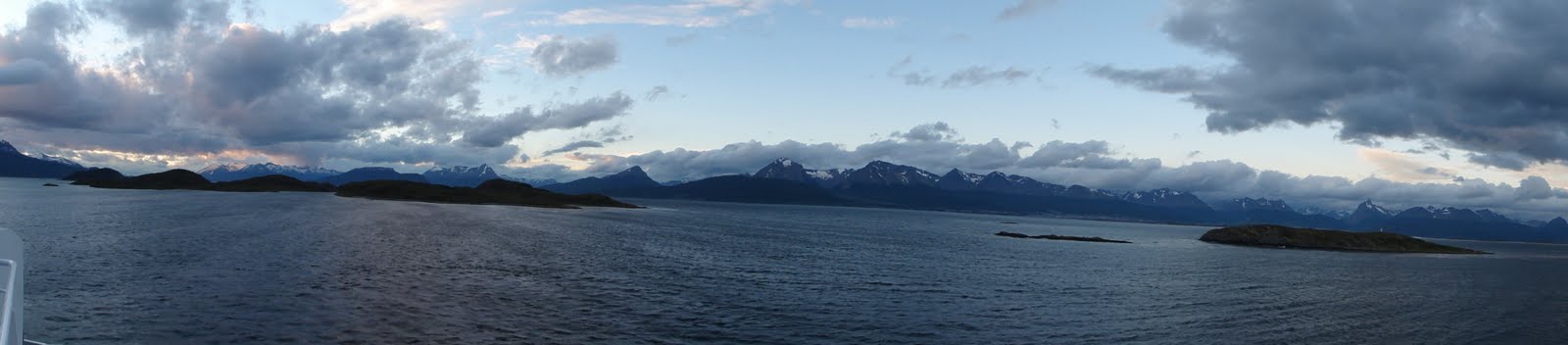
 The flight from Punta Arenas on Lan Chile is worth mentioning. The ‘plane, which came in empty from another place, was more than an hour late. As soon as it arrived, we were boarded. As the last 10 or so people entered the ‘plane, the door was shut behind them, the ‘plane was pulled away from the gate and taxied to the runway. The aforesaid people boarding last had to seat themselves during this process, with a number losing their balance and falling over in the aisle, dropping things, and struggling to put huge bags in the overhead lockers. The safety film came on as the ‘plane was lifting from the ground, with the hostesses running to their seats just before lift off. The journey to Santiago, scheduled to take 3 ¼ hours, took a little over 2 (with no tail wind !). At Santiago, the ‘plane descended so quickly I thought we were in a high speed elevator, with again the hostesses running to their seats at the last minute. On arrival, I expected the engines to be smoking ! As we filed out, the pilot stood at the entrance door smiling benignly at passengers, some had quite pale faces. Maybe the pilot was trying for the for the fastest flight ever between Punta Arenas and Santiago !
  We were in Santiago (population 5 million), for a couple of days. We stayed at a hotel in Providencia, a good quality suburb a few stops from the centre on an underground. Restaurants abounded in this suburb, with the food being very good, as was the beer and wine. Santiago is an unremarkable city, on a dry plateau. Its buildings are in general, not memorable.However, the largest shopping mall in South America (Parque Arauco) is located in one of its suburbs. It was immense, with numbers of good quality shops There is also a lookout on amountain rising near the centre of the city, and this was worth visiting.
A good holiday worth doing, with the Cape Horn cruise being the highlight. But a long way !
Pictures of Mendoza and the Andes
Pictures of Buenos Aires, Argentina
Pictures of Iguazu Falls
Pictures of Bariloche


 About 150 kms from the southern tip of Tierra del Fuego is the Beagle Channel. This is the second sea route between the two oceans, but is narrow and not easily navigable. The southern most point of Tierra del Fuego is Cape Horn, which fronts Drake Passage. This is the third sea route between the two oceans, and at Cape Horn, stretches 600 kms or so to the Antarctic continent. From the time of its discovery in the 16
 Strait was the main route used by commercial shipping, particularly in the transport of goods across North America before railways were established. As a consequence, the port of Punta Arenas (Chile), halfway along the Magellan Strait, became important for provisioning, coaling etc. However, the opening of the Panama Canal and the establishment of railways in North America lessened the usefulness of Punta Arenas, and it has now faded.
  Located on the Beagle channel is Ushuaia (pron. oos-why-a), in Argentina. This city promotes itself as the southern most city in the world (at 55 degrees south latitude). It probably is, although there are some small settlements nearby slightly further south (eg Puerto Williams, Chile), but these are not cities.
 We arrived in Ushuaia from Barriloche, further north in Argentina’s Lake district, using an ancient MD-11 operated by the national airline. Ushuaia now has a population of around 60,000. It is highly dependent on tourism, but in order to keep the population stable or increasing, the Government has arranged for electronic assembly companies to be established there , all paying higher than normal wages. There are minor agricultural activities near the city, in the form of large haciendas estates running sheep. Given the quality of the grass, these haciendas do not have a large carrying capacity. Tierra del Fuego was inhabited by aboriginal tribes. Around Ushuaia, the Yamana tribe lived. This was a highly primitive tribe, wearing few or no clothes (keeping warm by rubbing fats from penguins and sea lions on their bodies). They had no permanent settlements, moving constantly in their search for food – they ate penguins, mussels and sea lions, as well as edible berries. They moved around in canoes, and reportedly adult males and females could not stand erect, as their legs and knees became dysfunctional because of the constant kneeling in their canoes. The settlers brought diseases with them, and the Yamana had no resistance to these. Hence, within 2 years of the arrival of settlers, the Yamana had virtually died out, leaving little or no trace of their culture.
  Ushuaia is reasonably modern, with a downtown stretching along the Beagle Channel, and suburbs marching up a mountain range in rows of streets with small colourful houses in assorted and odd architectural styles. The mountain range ends in jagged snow covered peaks about 2500 metres high.


 (at present, a lighthouse keeper, his wife, and two small children live there. The appointment of lighthouse keeper is for twelve months, and volunteers are involved). There is a small shop attached to the quarters, this selling T-shirts and other souvenirs. A second walkway leads to the highest point on the Cape, where there is a monument meant to represent an albatross. By having my photo taken under this monument, a long held ambition of mine was
 achieved. The walkway to the monument crosses an unprotected part of the plateau, and here the wind was so violent that some elderly folk had to be assisted (me included), otherwise they would have been blown off the walkway, which again, had no handrails. The outlook south from the Cape over the Drake Passage is grim, to say the least. Clutching a pole and standing in cold screaming winds which freeze any unprotected skin, I could see nothing but a violent grey sea, with immense swells to the horizon (and presumably beyond this all the way to Antarctica). No vessels anywhere.
  Although the landing on Cape Horn was the undoubted highlight of the holiday, we were glad to return to the ship, to join fellow passengers for a hearty breakfast. A few of the passengers regretted their hearty breakfasts later. The ship moved out into the Drake Passage, where it was for more than 2 hours, before moving again to calmer waters. We had been warned that “there can be some movement” in the
  I thought this was an understatement ! The ship’s log showed that swells were 12 metres high, and the wind force (into which the ship was driving) was 100 knots. Some of the swells were enough to stop the vessel in its tracks. The movement of the ship was sufficient for cups and saucers to slide off tables, and in rooms (including ours), everything on shelves also fell off . Walking was very difficult although there were handrails in all passageways. In the lounge room, where
  many people were enjoying morning tea, there was chaos, and even the ship’s Xmas tree was swinging like a church bell and had to be secured to a wall. The crowd of morning tea drinkers quickly thinned as people rushed off to their rooms, and sea sick bags were distributed. I had no problems, but Kim retired to his bed to sleep, since there was nothing else to do and in the hope that this might alleviate nausea - surprisingly this worked.
 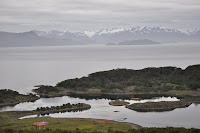 sparse flora as exist in southern Tierra Del Fuego can be seen. Amongst the berries is the barberry (El Calafate), which if eaten ensures that the person eating it will return to Patagonia. I ate some, but probably won’t last long enough to make the return journey !
  was a stunning sight. The glacier is approached by Zodiac boat, and close to it, there is unfortunately the overpowering smell of bird waste, from myriad birds which nest on the sheer cliffs of the fjord. The Piloto glacier is blue, this being caused by minerals in its the water, and we were told that the blue colour is the only colour that the human eye can discern, there being other colours the human eye cannot see. This glacier is now noticeably smaller than it once was, and our stay at it was punctuated by violent cracking sounds, as chunks fell off it. A stunning sight (which of course could only be viewed from the Zodiac).


 Our tour commenced in Boston (we had taken a commuter flight on arrival in New York). Incidentally this SIA flight uses Newark airport in New York, and it has to be said that this airport is barely above third world status (old, not particularly clean, few shops and restaurants). Boston (latitude 42 degrees N) is one of the oldest cities in the USA, having


